

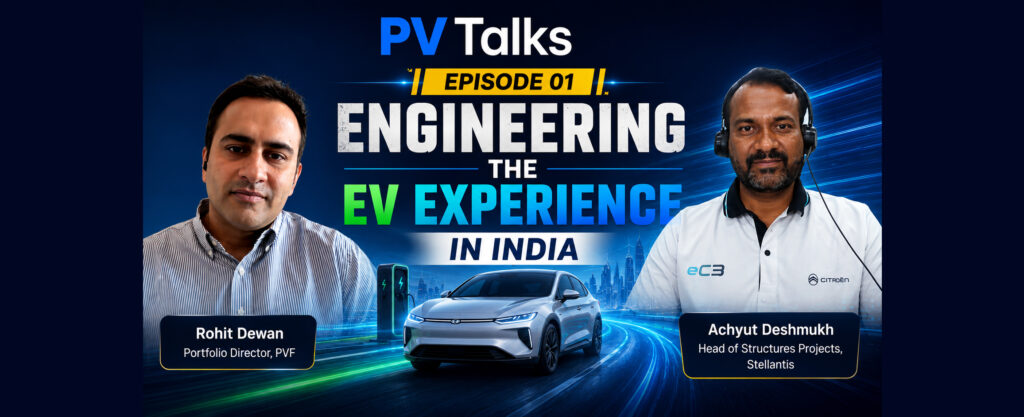
The passenger vehicle industry is undergoing one of its most significant technological shifts, with electrification changing not just the powertrain but the way vehicles are conceived, engineered and experienced by customers. From vehicle architecture and structural safety to charging, range, lightweighting and affordability, the transition to electric vehicles is bringing a new set of engineering challenges and opportunities.

These themes formed the central focus of the first episode of PV Talks, hosted by Rohit Dewan, Portfolio Director, Passenger Vehicle Forum (PVF). The episode featured Achyut Deshmukh, Head of Structures Projects at Stellantis, who shared his perspective on the engineering decisions shaping the next generation of passenger vehicles.
Drawing from his experience across global vehicle development programmes, structures, lightweighting and programme execution in multiple markets, Achyut Deshmukh offered an engineering-led perspective on how the passenger vehicle industry is evolving. The conversation looked beyond the battery and the electric motor to explore the wider vehicle architecture and the engineering considerations that ultimately shape the EV ownership experience.
One of the opening themes of the conversation was the broader technological shift that has taken place across the passenger vehicle industry. With Achyut having worked across organisations and global markets, Rohit explored the changes he has witnessed throughout his career and whether there was a particular point at which vehicle technology began undergoing a fundamental transformation. His experience provided a wider context for understanding the changes now taking place as the industry moves towards electrification.
A key takeaway from the discussion was that an EV cannot simply be viewed as a conventional internal-combustion vehicle with its engine replaced by a battery. The transition to electric powertrains has implications for the vehicle’s architecture and requires engineers to rethink several aspects of vehicle development. The conversation explored how significantly an EV needs to be redesigned from the ground up and how its architecture differs from that of a conventional passenger vehicle.
This shift becomes particularly important when considering vehicle structures and safety. With EV batteries typically adding substantial weight and being positioned beneath the vehicle floor, engineers have to consider how this changes the approach to structural rigidity, crash safety, underbody protection and occupant safety. As Head of Structures Projects at Stellantis, Achyut provided insight into the engineering considerations that customers may not always see but which play an important role in shaping the safety and performance of an EV.
The conversation then moved from vehicle engineering to one of the most discussed aspects of EV ownership: charging and range. While range anxiety is often associated with the battery itself, the discussion explored whether the challenge is increasingly connected to the charging ecosystem. Questions around charger availability, operational reliability, charging speeds and the ability to plan journeys around charging infrastructure have become important parts of the overall EV ownership experience.
From an OEM perspective, this raises a broader question about how much the charging ecosystem influences vehicle development. As EV adoption grows, vehicle engineering cannot be considered entirely in isolation from the infrastructure that supports it. The discussion highlighted the growing relationship between the vehicle, the charging network and the customer’s confidence in using an EV for everyday and longer-distance travel.
Another important theme was the relationship between battery size, vehicle weight and engineering efficiency. Bigger batteries can provide greater range, but they also add weight, material requirements and potentially cost. The conversation therefore explored whether the next major advances in EVs will come primarily from battery chemistry or whether lightweight engineering will become equally important.
Lightweighting has the potential to play a significant role in this equation. Reducing vehicle weight can have implications for efficiency and overall vehicle performance, while potentially helping engineers manage some of the cost and material challenges associated with larger battery packs. The discussion placed lightweight engineering within the broader question of how EVs can become more efficient and practical without relying solely on increasingly larger batteries.
Affordability was another major consideration, particularly in the Indian market. While battery costs remain an important factor in EV pricing, the discussion looked beyond batteries to consider what other engineering innovations could help make electric vehicles more accessible to the average Indian customer over the next five years. This brought the conversation back to the need for engineering solutions that balance technology, performance, safety and cost.
The discussion also explored what makes engineering specifically for India different from developing vehicles for other global markets. Achyut’s experience across multiple markets provided an opportunity to examine the challenges associated with Indian roads, climate, customer expectations, cost sensitivities and usage patterns. These factors can influence vehicle development decisions and highlight why solutions developed for other markets may need to be adapted to suit Indian conditions.
Looking ahead, the conversation considered how the EV landscape in India could evolve over the next five years. Rather than assuming that the transition will follow a single path, the discussion examined whether the decision to purchase an EV will continue to depend on factors such as where a customer lives, how the vehicle is used and the availability of charging infrastructure. The five-year outlook therefore brought together many of the themes discussed throughout the episode: vehicle engineering, affordability, infrastructure and customer usage.
The episode concluded with a rapid-fire discussion covering some of the questions currently shaping conversations around EV technology, including solid-state batteries, vehicle-to-grid technology, common EV myths, must-have EV features, advice for first-time EV buyers and the automotive technologies that are generating the most excitement.
A broader message emerging from the conversation was that the EV transition is much larger than simply replacing an internal-combustion engine with an electric powertrain. It involves rethinking vehicle architecture, structures, safety, charging, weight, cost and the overall relationship between the vehicle and its supporting ecosystem. Engineering decisions made at each of these levels will ultimately influence how customers experience electric mobility.
As the first episode of PV Talks, the conversation with Achyut Deshmukh provides an engineering-led look at the transformation taking place across the passenger vehicle industry. It offers a practical perspective on what lies beneath the EV experience, from the structure and architecture of the vehicle to the charging ecosystem and the engineering trade-offs involved in making electric mobility safer, more efficient and more accessible.
With PV Talks continuing its conversations with passenger vehicle leaders and industry experts, the first episode sets the stage for the discussions to follow. It also leads into the 4th Edition of Passenger Vehicle Forum (PVF) on 30th September 2026 at Hyatt Pune, Kalyani Nagar, where leaders from across the passenger vehicle ecosystem will come together to discuss the technologies, strategies and trends shaping the future of the industry.