
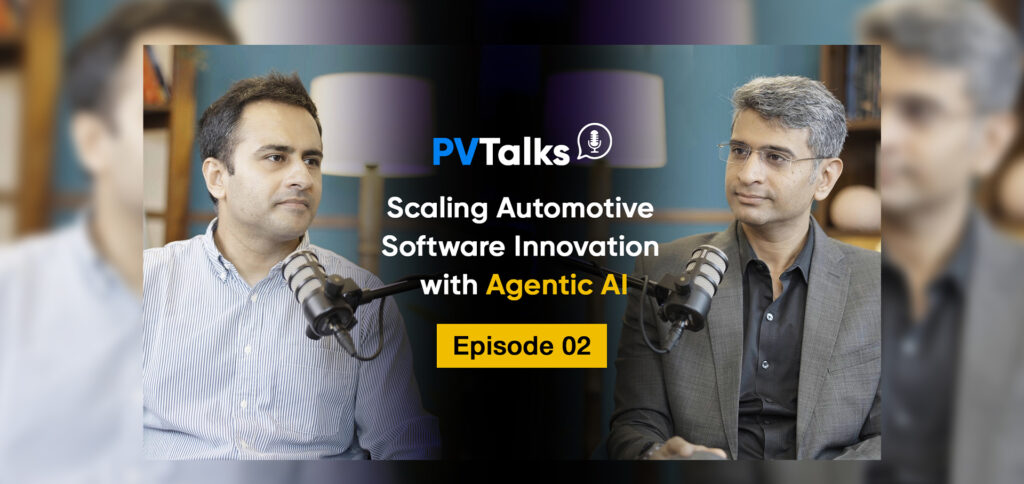
Scaling Automotive Software Innovation with Agentic AI
The passenger vehicle industry is moving through a fundamental shift in how vehicles are developed and experienced. As software becomes increasingly central to the modern vehicle, the industry is moving beyond traditional hardware-led development towards software-defined vehicles, connected systems and intelligent engineering processes. From Model Based Design and software development to testing, validation, functional safety and AI, this transformation is creating new opportunities as well as new challenges for automotive engineers.
These themes formed the central focus of Episode 02 of PV Talks, hosted by Rohit Dewan, Portfolio Director, Passenger Vehicle Forum (PVF). The episode featured Prasanna Deshpande, Application Engineering Manager at MathWorks, who shared his perspective on the evolution of automotive software and the emerging role of Agentic AI in engineering.
With close to 2 decades of experience across automotive software, eMobility and Model Based Design, Prasanna Deshpande offered an industry perspective on how software is changing the way vehicles are conceived and developed. Working closely with OEMs, suppliers and academic institutions, his experience provided a broader view of the opportunities presented by software-driven vehicle development.
The conversation began by examining how dramatically the role of software has changed within the automotive industry. When software was initially introduced into vehicles, it was often considered a supporting function alongside the primary mechanical and electrical systems. Today, that relationship has fundamentally changed. Modern vehicles increasingly resemble “computers on wheels”, with infotainment, connectivity, over-the-air updates and a growing range of software-enabled features becoming integral to the customer experience.
This transformation has also changed the engineering challenge. As more vehicle functionality moves into software, engineers are required to manage complex development environments while ensuring that the systems they create remain safe, reliable and compliant. The conversation therefore moved beyond the idea of software simply being another component of the vehicle to examine how software is becoming central to the overall vehicle architecture and development process.

One of the most significant themes of the episode was the emergence of Agentic AI. While conventional AI tools are increasingly being used to answer questions, support engineers and generate code, Agentic AI represents a potential shift towards systems that can take on more autonomous engineering activities. These systems could analyse requirements, generate test cases, identify defects and simulate scenarios, functioning in some respects more like an engineering teammate than a conventional software assistant.
For automotive engineering organisations, this raises an important question: where can Agentic AI genuinely create value? The discussion explored its potential across the broader engineering lifecycle, including requirements, verification, testing, calibration and validation. Rather than looking at AI simply as a faster way of writing software, the conversation considered how it could potentially support multiple stages of development and improve productivity across the engineering workflow.
At the same time, automotive software presents a unique challenge when compared with many other software industries. In automotive applications, software is closely connected to functional safety, reliability and regulatory compliance. The ability to accelerate development therefore cannot come at the expense of the standards required for vehicle systems.
This created another important theme in the conversation: the balance between speed and safety. Software organisations often operate with an emphasis on rapid development and iteration, while automotive engineering places an equally strong emphasis on safety, reliability and compliance. As AI begins to accelerate development processes, the industry must determine how to capture the benefits of that speed while maintaining the level of engineering discipline required for passenger vehicles.
The discussion then moved to one of the industry’s larger challenges: software complexity. Modern vehicles can contain hundreds of electronic control units, multiple software domains and increasingly centralised computing architectures. As vehicle functionality expands, the volume and complexity of software required to manage these systems continues to increase.

The question, therefore, is whether Agentic AI can help engineers tame this growing complexity or whether it introduces an additional layer that engineering organisations themselves will need to understand and manage. The conversation highlighted the importance of looking at AI not in isolation, but as part of a broader transformation in vehicle architecture and engineering processes.
Another important aspect of the discussion focused on the future role of the automotive engineer. If AI systems increasingly generate models, write code and create test cases, the differentiating skills of engineers could begin to change. Rather than eliminating the need for engineering expertise, the rise of AI raises questions about which capabilities will become more valuable.
For today’s automotive software engineers, this could mean developing skills that go beyond traditional coding. Understanding systems, engineering principles, vehicle behaviour, software architecture and the ability to critically evaluate AI-generated outputs could become increasingly important. The conversation positioned AI as a technology that may change the nature of engineering work while creating new expectations around the capabilities of the engineers working alongside it.
The conversation also brought the discussion to India’s position in the global automotive software landscape. India has traditionally been recognised for its engineering services and software talent, but the growth of software-defined vehicles and Agentic AI creates an opportunity to move beyond execution and towards innovation.
The question is no longer simply whether India can provide engineering resources to global automotive companies, but whether it can become a global centre for automotive software innovation. Achieving that transition will require continued development of engineering capabilities, deeper collaboration between industry and academia, and an ability to develop technologies and solutions that contribute directly to the future of the vehicle.

Looking ahead, the conversation fast-forwarded to 2031 and considered what the automotive industry might look like if Agentic AI delivers even a portion of its current promise. The potential transformation could extend well beyond the software inside the vehicle. AI could influence how requirements are created, how models are developed, how software is tested and how engineering teams manage increasingly complex development programmes.
This raises a broader question about where the biggest transformation will ultimately take place. While software will continue to change the vehicle itself, the engineering organisation developing that vehicle could undergo an equally significant transformation. The future passenger vehicle may therefore be shaped not only by new computing architectures and software capabilities, but also by fundamentally different ways of engineering and validating those systems.
The Episode concluded with a rapid-fire discussion covering some of the questions currently surrounding Agentic AI and automotive software. From the biggest misconception about AI in automotive engineering to the software tasks that could potentially be handed over to AI, the conversation also touched upon tasks that should never be executed independently by AI, technologies engineers should begin learning and the software trends likely to shape the next five years.
A broader message emerging from the conversation was that software innovation in the automotive industry is not simply about writing code faster. It is about building engineering systems that can manage growing complexity while remaining safe, reliable and intelligent. As AI evolves from an assistant into a potential engineering agent, the industry will need to determine where automation can create genuine value and where human engineering judgement must remain firmly in control.
The transition towards software-defined vehicles is therefore creating a new engineering landscape. Vehicle development is becoming increasingly connected to software architecture, modelling, simulation, testing, validation and AI-assisted workflows. The organisations that can successfully integrate these capabilities while maintaining engineering rigour will be better positioned to develop the next generation of passenger vehicles.