
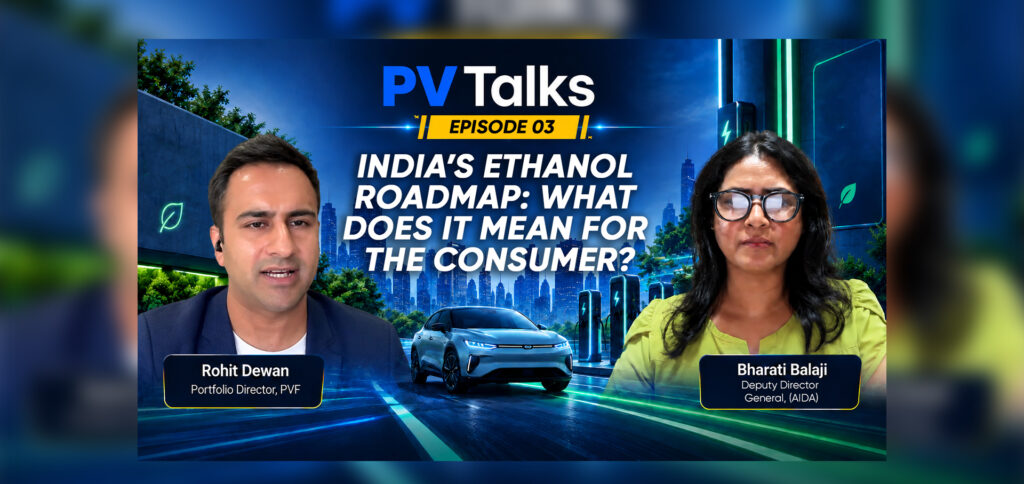
The Indian passenger vehicle industry is entering a period where the choice of powertrain is becoming increasingly influenced not only by technology, performance and price, but also by the changing energy landscape. As India progresses towards higher ethanol blending, consumers are beginning to ask important questions about what the transition means for the cars they buy, the fuel they use and the ownership experience they can expect over the next several years.
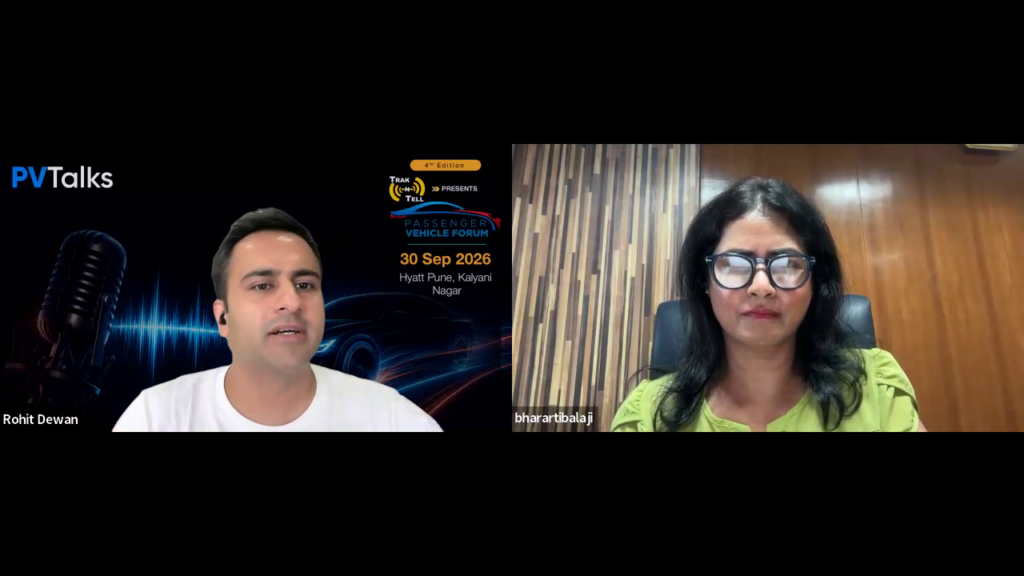
These questions formed the central focus of Episode 03 of PV Talks, hosted by Rohit Dewan, Portfolio Director, Passenger Vehicle Forum (PVF). The episode featured Bharati Balaji, Deputy Director General at the All India Distillers’ Association (AIDA). The conversation examined India’s ethanol roadmap through a consumer lens, exploring E20 compatibility, mileage, vehicle durability, flex-fuel vehicles, ethanol availability and the evolving relationship between ethanol, hybrid and electric vehicles.
The episode approached ethanol from the perspective of an everyday car buyer. With consumers increasingly hearing terms such as E20, E25, E30, E85 and E100, the conversation addressed the uncertainty surrounding what these developments actually mean when someone is standing in a showroom deciding which car to purchase.
The discussion began with perhaps the most basic question facing consumers today: should someone buying a new petrol car have any hesitation because of India’s transition towards higher ethanol blends?
For a buyer expecting to keep a vehicle for seven to ten years, the question goes beyond the fuel available today. Consumers want to understand whether a petrol vehicle purchased now will remain relevant as the fuel ecosystem evolves. This makes E20 compatibility an increasingly important consideration when evaluating a new vehicle.
The conversation highlighted the importance of understanding the difference between a vehicle being compatible with E20 and one being optimised for E20. For consumers, this distinction can be significant because compatibility is not simply a technical specification; it can influence how confidently a buyer approaches long term ownership.
This naturally led to one of the most widely discussed concerns around ethanol: mileage. Ethanol has a lower energy density than petrol, which can potentially influence fuel economy. For consumers accustomed to thinking about vehicle efficiency in terms of kilometres per litre, even a relatively small change can become an important consideration. The episode explored how much of the mileage discussion around E20 is supported by engineering and scientific considerations, and how much has been amplified through speculation and social media conversations. The question of mileage, however, is only one part of the ownership equation.
Long-term durability is another major concern. Consumers frequently encounter claims about potential impacts on engine components, fuel systems, seals and corrosion. For someone purchasing a vehicle with the expectation of keeping it for seven or ten years, understanding the implications of prolonged exposure to higher ethanol blends becomes critical.
The discussion therefore moved beyond the immediate E20 transition to consider what happens next. Today, E20 is at the centre of the conversation, but India could potentially move towards higher blends in the future. Consumers who purchase an E20-compatible vehicle today may therefore wonder what happens if the fuel ecosystem gradually moves towards E25, E30 or beyond.
This creates a new dimension to the car buying decision. A vehicle may remain mechanically sound while being less aligned with a changing fuel ecosystem. For consumers, the challenge is therefore not simply understanding today’s fuel standard, but anticipating how the fuel landscape could evolve over the lifetime of the vehicle.
This is where the concept of flex-fuel vehicles becomes particularly relevant. From a consumer perspective, flex-fuel technology offers an attractive proposition: a vehicle capable of operating across a much wider range of ethanol blends could potentially reduce some of the uncertainty associated with future fuel availability. Instead of being designed around a particular blend, such vehicles can provide greater flexibility as the fuel mix evolves.
But the discussion also examined why flex-fuel vehicles are not already the obvious choice for every passenger vehicle buyer. Higher ethanol compatibility requires changes across the vehicle’s technical systems. Understanding these engineering requirements is important when considering whether flex-fuel technology can become a mainstream passenger vehicle solution in India or whether it will remain a more specialised technology serving particular applications and use cases.
The conversation then moved from the vehicle to the fuel itself. If India eventually moves towards significantly higher ethanol blends, one of the fundamental questions is whether the country will have sufficient ethanol supply to support that transition. India’s distillery capacity has expanded considerably, while the industry has also diversified its feedstock base, including greater use of grain and maize.
This evolution is important because the success of a higher-blend strategy ultimately depends on more than vehicle compatibility. There must also be a sufficiently robust and sustainable ecosystem capable of producing, distributing and supplying the required quantities of ethanol.
The discussion also touched upon some of the broader questions associated with expanding ethanol production. As demand grows, issues such as food versus fuel, water consumption and agricultural economics become increasingly relevant. The ethanol transition therefore sits at the intersection of automotive, energy, agriculture and environmental considerations.
For consumers, however, one question continues to dominate almost every purchasing decision: what does it mean for my wallet? If ethanol has lower energy density and influences mileage, consumers naturally want to understand the economic benefit of using it. While ethanol blending can contribute to national objectives such as reducing crude oil imports and strengthening domestic energy security, the more immediate question for an individual car buyer is whether those benefits translate into meaningfulsavings at the fuel pump.
The episode explored whether increasing ethanol blending could eventually result in significantly lower petrol prices or whether the primary economic benefit will continue to operate at the broader national level through reduced dependence on imported crude and the development of a domestic biofuel ecosystem. Another major focus of the conversation was the gap between perception and reality.
Ethanol has become a subject of intense discussion on social media, where consumers encounter claims about dramatically lower mileage, engine damage, corrosion and fuel system problems. Some concerns have a technical basis, while others can become exaggerated or disconnected from the actual engineering realities of modern vehicles.
The episode therefore placed particular emphasis on distinguishing genuine consumer considerations from misconceptions. For someone buying a petrol vehicle today, this distinction is important. Fear driven by incomplete information can be just as problematic as ignoring legitimate technical considerations. Consumers need clear, credible information that allows them to understand what E20 means for their specific vehicle rather than relying on fragmented claims circulating online.
This led naturally to another critical stakeholder in the transition: automotive manufacturers. One of the strongest themes emerging from the discussion was the need for clearer communication from OEMs. For many consumers, a statement such as “E20 compatible” does not necessarily answer the questions that matter most. A buyer wants to know what fuel blend the vehicle is designed for, whether mileage could change, what the implications are for long-term durability and what happens if India’s fuel ecosystem moves towards higher blends in the future.
Greater transparency from manufacturers could therefore play an important role in reducing consumer uncertainty. As the fuel landscape evolves, customers will increasingly expect vehicle manufacturers to communicate not just technical specifications, but also the practical implications of those specifications for ownership.
The conversation also addressed the question that inevitably arises when discussing the future of petrol vehicles: should consumers simply buy an EV instead? For a buyer choosing between a petrol vehicle, an EV or a hybrid, the ethanol transition adds another layer to an already complex decision. If consumers are concerned about the future fuel mix, moving directly to electric mobility may appear to eliminate that uncertainty altogether.
However, the discussion positioned ethanol and EVs not necessarily as mutually exclusive pathways. India’s passenger vehicle market is diverse, with different consumer requirements, driving patterns, infrastructure availability and use cases. It is therefore possible that multiple powertrain technologies will coexist, with EVs serving some applications while ethanol compatible, flex-fuel and hybrid vehicles address others.
This broader powertrain diversity could become an important characteristic of India’s automotive transition. The discussion ultimately looked towards 2030 and considered what India’s fuel landscape could look like by then. For a consumer purchasing a petrol vehicle today, the question is whether the familiar experience of simply driving to a petrol station and filling up will remain unchanged, or whether higher ethanol blends will become increasingly normal. The availability of flex-fuel vehicles, the growth of EVs and hybrids, and the evolution of India’s fuel infrastructure could all influence the choices available to consumers.
For someone planning to own a vehicle for seven to ten years, this makes understanding the direction of the transition particularly important. The episode concluded with a rapid fire discussion that distilled some of the biggest questions surrounding ethanol today. From the biggest myths surrounding E20 and the most genuine concerns, to questions around mileage, flex-fuel vehicles, the possibility of E100 and the one thing every Indian car buyer should know, the segment brought the conversation back to the individual consumer.
At its core, the discussion revealed that the ethanol debate is not really about percentages. For consumers, it is about confidence. When someone invests ₹10 lakh, ₹15 lakh, ₹20 lakh or ₹30 lakh in a new vehicle and expects to own it for many years, they want confidence that the decision they make today will continue to make sense as India’s mobility and energy ecosystem evolves.